How a European wall décor brand turned €41K of Pinterest spend into €621K of revenue — at a 14.82× ROAS.
A 14-month, mid-budget Pinterest campaign for a France-based wall décor brand selling premium murals and large-format wall art across the EU. Over 30 million impressions. 5,188 add-to-carts. 1,365 checkouts. A €455 average order value sustained across 14 months, at €0.11 per outbound click.
14.82×ROAS
€621,638Pinterest revenue
€30.73CPA / checkout
€0.11CPC / outbound
How ROAS is measured
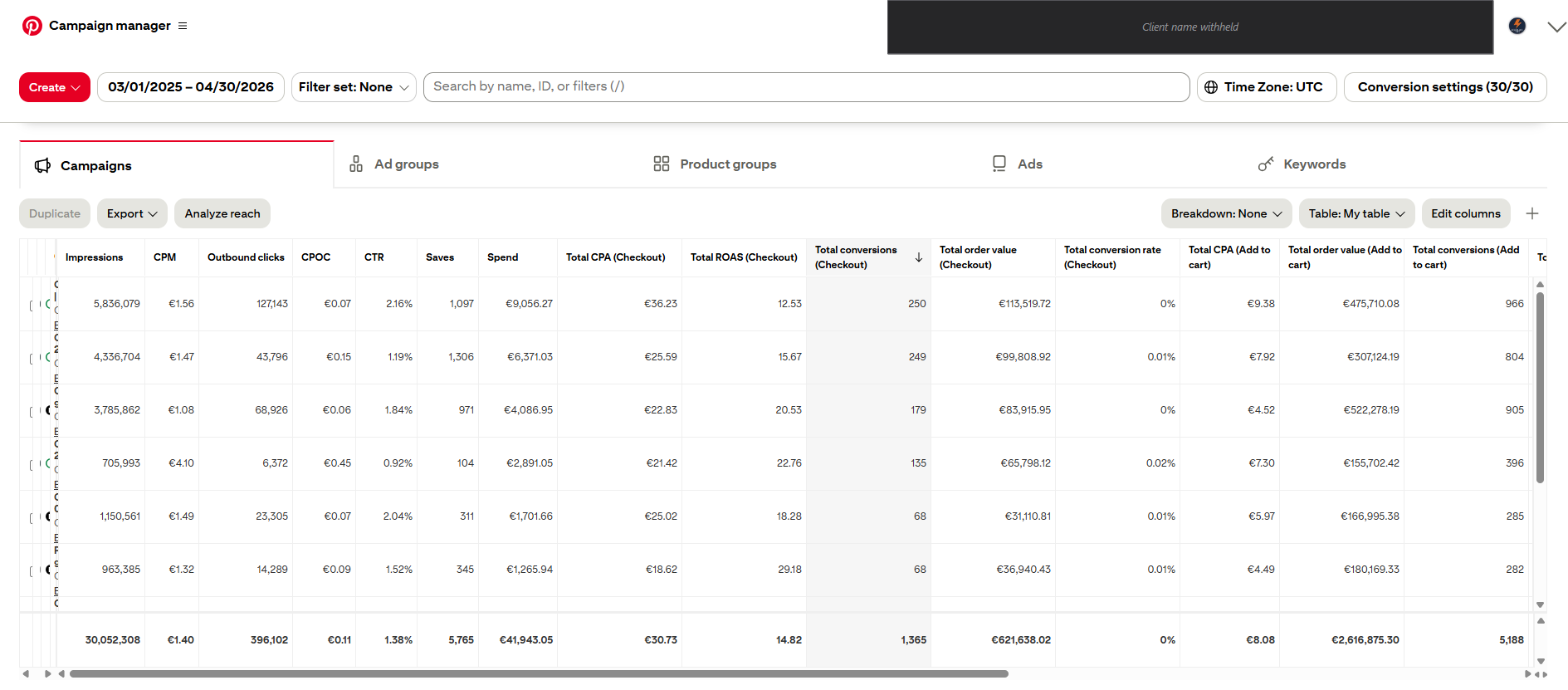
30-day click / 30-day view attribution. Pinterest Tag + Conversions API, deduplicated via event_id. Revenue = platform-reported order value in EUR. Numbers match the Ads Manager screenshot on this page exactly.
Why the client name is withheld
At their request. Competitors in tight European categories actively study each other’s marketing. The numbers and screenshot are verbatim from Ads Manager. Full export available under NDA on request.
European wall décor brand · France · Premium murals & large-format wall art · client name withheld
The brief: scale Pinterest into a primary revenue channel — without the ROAS collapsing.
The client is a France-based wall décor brand selling premium murals, large-format wall art and statement wallpapers across the European Union. By the time the engagement started, they had built a respected aesthetic, a clean storefront, and a loyal organic following — but Pinterest was inconsistent. Spend would scale, ROAS would slip. Spend would pull back, ROAS would recover. The classic pattern of a funnel that breaks as budget rises.
The category itself is unforgiving. Wall décor is a considered purchase: a customer measures the wall, lives with the idea for a few weeks, and only then commits to a €400–€500 order. That makes Pinterest’s long consideration window a feature, not a bug — but it also means a playbook judged on a 7-day attribution window doesn’t transfer to this category.
The brief was straightforward. Build a Pinterest funnel that could absorb €3,000+/month of spend, hold ROAS at 12×+, and do it across 14 months without burning out audiences.
Three problems that stall wall-décor Pinterest accounts as budgets grow.
01
Scaling spend without scaling fatigue
In our experience the default Pinterest playbook works at €30–50 a day. Push toward €100 a day and CPMs rise, frequency climbs, and the Pin that sold well last week stops working. Many wall-décor accounts stall here.
02
A €455 AOV that requires real consideration
Wall décor isn’t impulse. The customer measures, lives with the idea, talks to a partner, then converts. A 7-day click window misses purchases that happen later, and so does a funnel built on one ad and an immediate click.
03
Visual category, ruthless pin standards
Pinterest’s algorithm rewards aesthetic. Wall décor competes against interior-design editorials, AD-grade photography, and major brand content teams. Mediocre product shots get buried. That makes creative the bottleneck — not the budget.
THE APPROACH
Build a four-stage funnel that stays cheap as it scales — and let the consideration window do the heavy lifting.
STAGE 01
Awareness at scale
Standard and video Pins targeting unbranded interior-design searches: “feature wall ideas,” “modern mural living room,” “statement wallpaper bedroom.” This is where most of the 30M impressions came from, and where the €0.11 cost per outbound click was built. We weighted budget toward this stage because cheap, high-quality reach upstream is what makes the conversion maths work.
STAGE 02
Consideration via saves
Saves tracked as a primary upstream KPI alongside outbound clicks. A save usually means someone is building a board for a project, not just browsing. 5,765 saves over 14 months. Savers became a retargeting audience for Stage 04.
STAGE 03
Conversion via Performance+
Pinterest Performance+ Catalog Sales with Direct Links enabled, structured by mural style (botanical / geometric / mountainscape / etc.). 30/30 conversion settings, because a 7-day window under-reports a purchase people take weeks to make.
STAGE 04
Retention on long windows
Retargeting tiers at 7 / 30 / 90 days, abandoned-cart sequences, and customer-list lookalikes off purchaser emails. The €455 AOV makes retention spend punch above its weight — a single recovered cart brings in about €455 of revenue for little extra ad spend.
PINTEREST TAG + CONVERSIONS API · CONSENT-AWARE EVENTS · 30-DAY CLICK / 30-DAY VIEW · DEDUPED VIA EVENT_ID · COOKIE CONSENT-RESPECTING
European tracking has more gaps: consent choices under GDPR, iOS privacy limits and Safari’s tracking prevention all reduce what the browser tag can see. The Conversions API recovers consented conversions the tag misses, and event_id deduplication stops any checkout being counted twice, so the reported figure is more complete without being inflated.
THE RESULTS · 14 MONTHS · MAR 2025 – APR 2026
€41,943 in. €621,638 out. 14.82× back.
€621,638
Pinterest-attributed revenue
over 14 months
14.82×
Total ROAS (Checkout)
on €41,943.05 spend
1,365
Checkouts
tracked via Pinterest Tag + CAPI
€455.41
Average order value
premium murals and wall art
5,188
Add-to-carts
26.3% cart → checkout rate
€30.73
CPA per checkout
6.7% of the average order
€0.11
CPC outbound
14-month average per outbound click
30.1M
Impressions
Ads Manager total, 14 months
CAMPAIGN-LEVEL BREAKDOWN
“A 14.82× ROAS across 14 months is one number. The story underneath is that even the weakest of the six largest campaigns returned 12.53×.”
Campaign
Spend
Revenue
ROAS
AOV
Top performer #1
€1,265
€36,940
29.18×
€543
Cold prospecting
€2,891
€65,798
22.76×
€487
Awareness scale
€4,086
€83,915
20.53×
€469
Retargeting
€1,701
€31,110
18.28×
€458
Catalog Sales — primary
€6,371
€99,809
15.67×
€401
Hero pin + lookalikes
€9,056
€113,520
12.53×
€454
Figures rounded to whole €. The six largest campaigns by checkouts: €25,373 of the €41,943 total spend and 949 of the 1,365 checkouts. Lowest ROAS among them: 12.53×. Highest: 29.18×.
FULL-FUNNEL PERFORMANCE WATERFALL
Impressions
30,052,308
Outbound clicks
396,102
1.32% outbound CTR
Saves
5,765
project-intent signal
Add-to-carts
5,188
1.31% of clicks
Checkouts
1,365
26.3% of carts
Note: 26.3% of add-to-carts became checkouts. Source: Pinterest Ads Manager · Mar 2025 – Apr 2026 · 30-day click / 30-day view · CAPI deduped.
PINTEREST ADS MANAGER — FULL PERIOD SCREENSHOT
Account-level export: all campaigns, Mar 1 2025 – Apr 30 2026. Numbers visible in screenshot match figures on this page exactly.
Screenshot taken Apr 2026. Account name redacted. Full export available under NDA on request.
Want results like these for your store?
Free 30-minute account review. We look at your current setup and show you the gap. No account access required.
“At a 50% gross margin, €621,638 of revenue is about €310,800 of gross profit. That’s about 7.4× the €41,943 ad spend (profit on ad spend, or POAS), roughly €268,900 left after paying for the ads.”
Margin assumption: 50% gross, our estimate for premium printed wall décor; our 2026 benchmarks don’t list a wall-décor category. The client’s actual margin is confidential, so treat this as an estimate.
What the €0.11 click cost and the campaign spread tell you.
01
€0.11 per outbound click, across 396,102 clicks. That isn’t one well-optimized ad; it came from creative, targeting and 14 months of results feeding back into the account. Cheap clicks only matter if they convert: 1.31% of outbound clicks added to cart, and 26.3% of carts checked out.
02
30 million impressions also built the brand. Performance teams often ignore impressions because they don’t attribute directly. For a wall-décor brand they matter: repeated exposure on searches like “feature wall” and “statement mural” makes the brand familiar before the purchase. That familiarity is hard to measure, so we don’t count it in ROAS, but it doesn’t vanish when a campaign pauses.
03
26.3% of carts became checkouts on a €455 purchase. Baymard Institute puts average online cart abandonment at about 70%, so roughly 30% of carts convert across e-commerce. Holding close to that on a considered purchase, where the customer has to measure the wall first, suggests the creative and landing pages set accurate expectations before the add-to-cart.
04
The weakest of the six largest campaigns returned 12.53×. A single promotion can hit 25× for a week. Holding 12× as the floor across the six campaigns that carried 60% of spend is what separates a system from a streak. It also means budget can be scaled without one campaign quietly carrying the others.
WHAT THIS MEANS FOR YOUR STORE
If you’re spending €1,000+ a month on Pinterest and ROAS slips each time you scale, this case shows one way through.
This case is the answer to the most common question we hear from growing home-décor brands: “Pinterest worked great at €30 a day. We tried to scale it to €100 a day and ROAS collapsed. What happened?”
Usually, most of the spend sat in conversion campaigns aimed at a small in-market audience, so frequency climbed, creative wore out and CPMs rose. More conversion budget rarely fixes that. Rebuilding the awareness layer, so the funnel keeps refilling at the top, often does.
This 14-month wall-décor case is what that looks like in practice: the bulk of impressions came from awareness, saves were tracked as a leading indicator, and Performance+ catalog campaigns carried conversion. The method carries over to murals, rugs, lighting, tile, furniture or pillows; the campaign structure is chosen for each account.
Free 30-minute account review. Zero pressure. We’ll show you exactly where your Pinterest spend is leaking — and what scaling it properly would look like.
At their request. Many clients prefer to keep performance numbers confidential — particularly when competing in tight European categories where competitors actively study each other’s marketing. The numbers, screenshots, and methodology on this page are exactly as reported in Pinterest Ads Manager. Available for verification on request under NDA.
Does this work outside of Europe?
Yes. This case happens to be a European brand because they were the right anonymized example to publish, but the approach — buying-question research, an accurate catalog, distinct creative tests, Performance+ catalog campaigns where they fit and CAPI tracking — is the same for U.S. accounts. Our New Jersey tile case (also linked here) shows it delivering 14.93× for a U.S. brick-and-mortar store on about half the budget.
Can you scale my account past €3K/month spend?
Possibly, but this case doesn’t prove it on its own: this account averaged about €3,000 a month for 14 months at 14.82×. Whether yours can go further depends on your catalog, creative supply, margins and how much in-market demand there is. We raise budget in steps and watch cost per checkout at each step; when ROAS slips as spend grows, the first thing we check is whether the awareness layer is keeping the funnel full.
What if my AOV is lower — €50, not €450?
It can work at lower order values, but the maths changes. A €50 order needs cheaper clicks and a higher conversion rate to earn the same return, and your break-even ROAS depends on your margin, not your order value. We’d treat an average order below about €30 as hard to make profitable on Pinterest ads; above that, we model it from your own margins before recommending a budget.
FOUNDER, DECORADSPRO · 7 YEARS IN PAID MEDIA, NOW HOME-DECOR ONLY · PINTEREST CERTIFIED MEDIA BUYER · UPDATED OCTOBER 30, 2026
Want a Pinterest funnel built to scale?
Free 30-minute account review. Zero pressure. We’ll show you exactly where the wasted spend is and what a Pinterest-led plan would look like for your store.
Used by furniture, lighting, rug, tile and decor brands across the U.S., U.K., Canada and Europe.
All metrics sourced directly from Pinterest Ads Manager reporting for the client account, window March 1, 2025 – April 30, 2026. Conversion settings 30/30 (30-day click, 30-day view). The Ads Manager screenshot is shown on this page; campaign-level exports are available under NDA on request. Client name withheld at client request.