PINTEREST ADS · 19 MONTHS · NEW JERSEY TILE RETAIL
How a New Jersey tile wholesaler turned $20K of Pinterest spend into $308K of revenue — at a 14.93× ROAS.
A 19-month, full-funnel Pinterest build for a brick-and-mortar tile retailer in New Jersey. Zero existing Pinterest presence at the start. Over those 19 months: 4.14 million impressions, 1,054 checkouts and a $292.72 average order value, from a channel the store had never advertised on.
14.93×ROAS
$308,524Pinterest revenue
$19.60CPA / checkout
$0.30CPC / outbound
How ROAS is measured
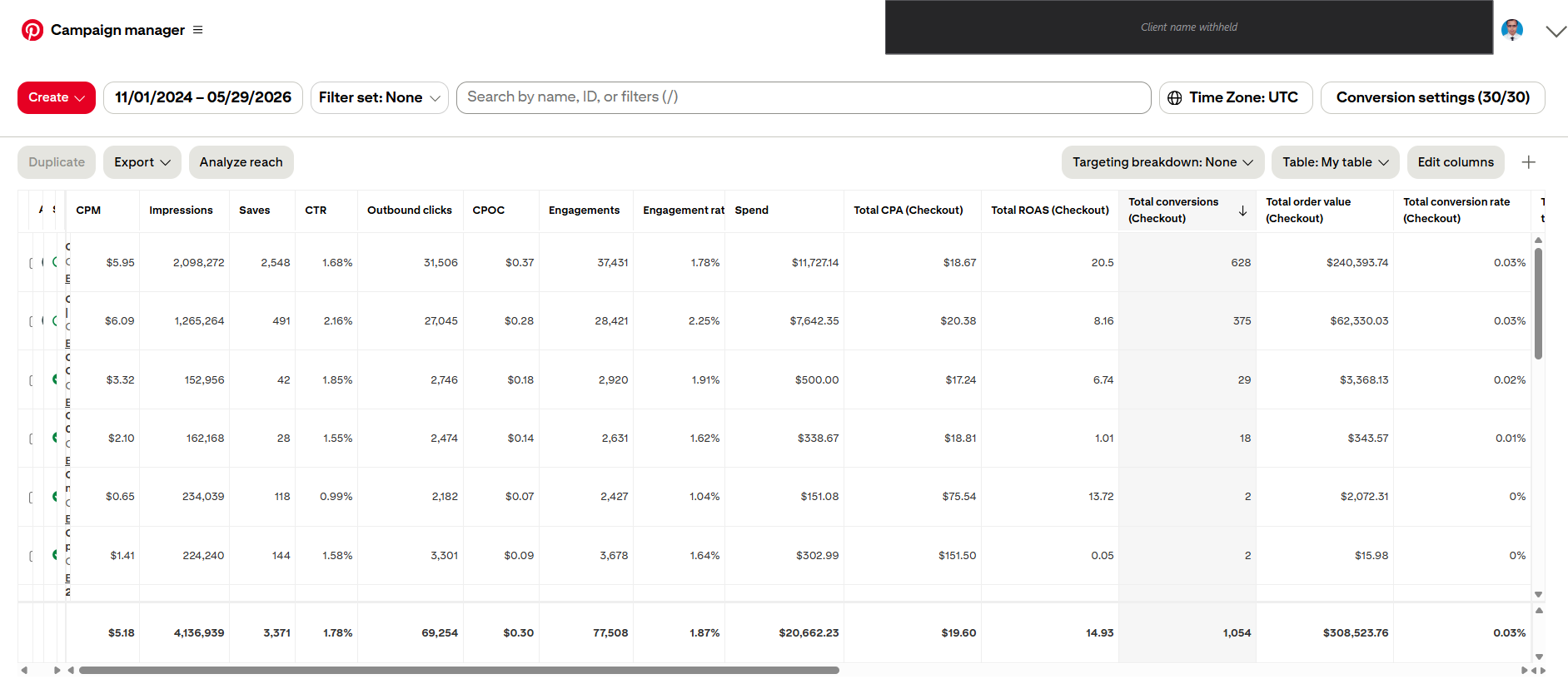
30-day click / 30-day view attribution. Pinterest Tag + Conversions API, deduplicated via event_id. Revenue = order value of Pinterest-attributed checkouts, as passed from BigCommerce. Numbers match the Ads Manager screenshot on this page exactly.
Why the client name is withheld
At their request. Competitors actively study performance marketing in this category. The numbers and screenshot are verbatim from Ads Manager. Full export available under NDA on request.
New Jersey tile retailer & wholesaler · Subway tile, mosaic, hexagon, large-format porcelain and slab
The brief: a regional tile store going up against national e-commerce.
This client is a New Jersey tile retailer and wholesaler — the kind of regional brick-and-mortar that has lived through every shift in the home-decor category, from Home Depot’s expansion to the Wayfair tile aisle to Floor & Decor opening down the road.
When the engagement started in October 2024, the client had a competitive product range (porcelain, mosaic, hexagon, subway, slab, stone) and a clean BigCommerce storefront — but no Pinterest presence to speak of. Their digital spend was almost entirely on Google search, where every dollar was being bid up by national players with co-op budgets the average independent simply can’t match.
On Google, the category looked locked up. Pinterest offered a different starting point: people plan kitchens and bathrooms there weeks before they buy, usually before they have chosen a store.
LOCATION: NEW JERSEY · PLATFORM: BIGCOMMERCE · CATEGORY: TILE RETAIL + WHOLESALE · CHANNEL: PINTEREST ADS · ENGAGEMENT START: OCT 2024
THE CHALLENGE
Three problems no amount of Google budget was going to fix.
01
A category dominated by national chains
Floor & Decor, The Tile Shop, Wayfair and Home Depot were sitting on top of Google for most transactional tile searches. CPCs on terms like “subway tile” and “mosaic backsplash” were being bid past what any single-store independent could justify.
02
A purchase that takes weeks, not minutes
Tile is a project purchase. Customers take weeks from inspiration to checkout — looking at rooms, gathering samples, getting contractor quotes. Standard last-click attribution was hiding most of the funnel and most of the real value.
03
No discovery channel
The store had a great product range but no upper-funnel demand creation. Customers had to already know they wanted tile to find them. Pinterest — where people plan rooms and 97% of top searches are unbranded — was completely untapped.
THE APPROACH
A four-stage Pinterest funnel — engineered around how tile actually gets bought.
STAGE 01
Awareness
Standard and video Pins targeting unbranded inspiration searches: “modern bathroom tile,” “kitchen backsplash ideas,” “floor tile pattern.” Reaching people planning a project weeks ahead, before they’ve picked a store.
STAGE 02
Consideration
Catalog-driven Carousel and Collection pins showing actual SKUs in styled room scenes. Saves and outbound clicks tracked as upstream KPIs — early signs of the checkouts that followed weeks later.
STAGE 03
Conversion
Pinterest Performance+ Catalog Sales with Direct Links enabled, structured by category (porcelain / mosaic / subway / hexagon / slab) with bid optimization on checkout events via Pinterest Conversions API.
STAGE 04
Retention
Retargeting tiers (7-day / 30-day / 90-day site visitors), cart abandoners, and a customer-list lookalike off purchaser emails. In this account many checkouts came 14–30 days after the first ad view, which is why the 30-day windows matter.
PINTEREST TAG + CONVERSIONS API · BIGCOMMERCE EVENTS · 30-DAY CLICK / 30-DAY VIEW WINDOW · DEDUPED VIA EVENT_ID
Server-side conversions matter more when the buying journey runs for weeks. The Conversions API recovers checkouts the browser tag misses because of iOS privacy limits, ad blockers and browser cookie restrictions, and event_id deduplication stops any checkout being counted twice.
THE RESULTS · 19 MONTHS · NOV 2024 – MAY 2026
$20,662 in. $308,524 out. 14.93× back.
$308,524
Pinterest-attributed revenue
over 19 months
14.93×
Total ROAS (Checkout)
on $20,662.23 spend
1,054
Checkouts
tracked via Pinterest Tag + CAPI
$292.72
Average order value
high-AOV category
3,371
Saves
project-intent signals
$19.60
CPA per checkout
against a $292.72 AOV
$0.30
CPC outbound
19-month average per outbound click
4.14M
Impressions
Ads Manager total, 19 months
FULL-FUNNEL PERFORMANCE WATERFALL
Impressions
4,136,939
Outbound clicks
69,254
1.67% outbound CTR
Saves
3,371
project-intent signal
Engagements
77,508
1.87% rate
Checkouts
1,054
1,054 checkouts
Source: Pinterest Ads Manager · Nov 2024 – May 2026 · 30-day click / 30-day view · Conversions API + Pinterest Tag deduped via event_id.
PINTEREST ADS MANAGER — FULL PERIOD SCREENSHOT
Account-level export: all campaigns, Nov 1 2024 – May 29 2026. Numbers visible in screenshot match figures on this page exactly.
Screenshot taken May 2026. Account name redacted. Full export available under NDA on request.
Want results like these for your store?
Free 30-minute account review. We look at your current setup and show you the gap. No account access required.
“At a 35% gross margin, $308,524 of revenue is about $108,000 of gross profit after cost of goods. That’s about 5.2× the $20,662 ad spend (profit on ad spend, or POAS), roughly $87,000 left after paying for the ads.”
Margin assumption: 35% gross, the tile & stone figure in our 2026 home decor benchmarks (break-even ROAS 2.86×). The client’s actual margin is confidential, so treat this as an estimate.
What the numbers show, beyond the headline ROAS.
01
$0.30 per outbound click, averaged over 19 months. Cheap clicks only matter if they turn into orders. Here about 1.5% of outbound clicks became checkouts (1,054 of 69,254), so an average budget of about $1,100 a month kept producing sales.
02
Two campaigns carried the account; the tests stayed small. The two largest campaigns took $19,369 of the $20,662 spend and produced 1,003 of the 1,054 checkouts, at 20.5× and 8.16× ROAS. Four smaller tests cost $1,293 between them, and the two that didn’t pay back (1.01× and 0.05×) spent about $300 each.
03
3,371 saves: an early signal most reports leave out. A save usually means someone is collecting ideas for a project. Saves feed retargeting and actalike audiences, and in our accounts a rise in saves has often come a few weeks before a rise in checkouts.
04
14.93× ROAS over 19 months is not a “lucky month.” A single promotion can hit 20× for a week. Holding 14.93× across 574 days, two holiday seasons and 2025’s tariff changes on imported tile takes a system, not one lucky campaign.
WHAT THIS MEANS FOR YOUR STORE
If you sell tile, lighting, rugs, furniture or home accents, the same method applies to your store.
This build wasn’t a one-off, and it isn’t a template either. The same approach — buying-question research, an accurate catalog, distinct creative tests, Performance+ catalog campaigns where they fit, and CAPI-hardened tracking — is how we run furniture showrooms, lighting retailers, rug galleries and pillow brands, with the campaign structure chosen for each account.
What changes is the creative, the category-specific keyword clusters, and the offline-conversion setup if you have a physical showroom. What stays the same is the method: research, an accurate catalog, creative tests and purchase-based reporting.
If you’re spending $1,000–$5,000 a month on ads and Pinterest isn’t part of the plan, that is often the first gap we look at.
No. Tile is a high-AOV, project-driven category, but the same approach works for furniture, lighting, rugs, pillows and wall décor: research the buying question, keep the catalog accurate, test distinct creative and report on purchases. The campaign structure is chosen for each account’s products and data. The $0.30 cost per outbound click and 14.93× ROAS are this account’s results after 19 months of optimization, not a forecast for yours.
What if I have a physical showroom and not just a website?
That works too. For showrooms we add store-focused measurement to the same funnel: offline conversion uploads where your point-of-sale data allows, location-targeted Pins, Google store-visit reporting where your account is eligible, and local SEO. This client has a physical store, but every figure on this page is online checkouts only; in-store sales are not counted.
How long until I see results like this?
The 19-month figure shows what sustained results looked like in this account; it isn’t a timeline for yours. We aim to launch 10 to 14 days after onboarding, and the day-30 pilot review shows what the evidence supports so far. Purchase results need time and volume, and project purchases like tile take longer, so we don’t promise a first-sale date or a ROAS deadline.
What’s a realistic ad budget to start at?
Our 30-day pilot plans $1,500 of ad spend (our starting budget, not a Pinterest minimum). After that we recommend $3,000 or more a month for Pinterest on its own, so each test gets enough delivery to read. This client averaged about $1,100 a month over 19 months, so a smaller budget can work when prices and margins support it.
FOUNDER, DECORADSPRO · 7 YEARS IN PAID MEDIA, NOW HOME-DECOR ONLY · PINTEREST CERTIFIED MEDIA BUYER · UPDATED OCTOBER 30, 2026
Want a Pinterest funnel built for your store?
Free 30-minute account review. Zero pressure. We’ll show you exactly where the wasted spend is and what a Pinterest-led plan would look like for your store.
Used by furniture, lighting, rug, tile and decor brands across the U.S., U.K., Canada and Europe.
All metrics sourced directly from Pinterest Ads Manager reporting, window Nov 1, 2024 – May 29, 2026. Conversion settings 30/30 (30-day click, 30-day view). The Ads Manager screenshot is shown on this page. Client name withheld at the client’s request.